
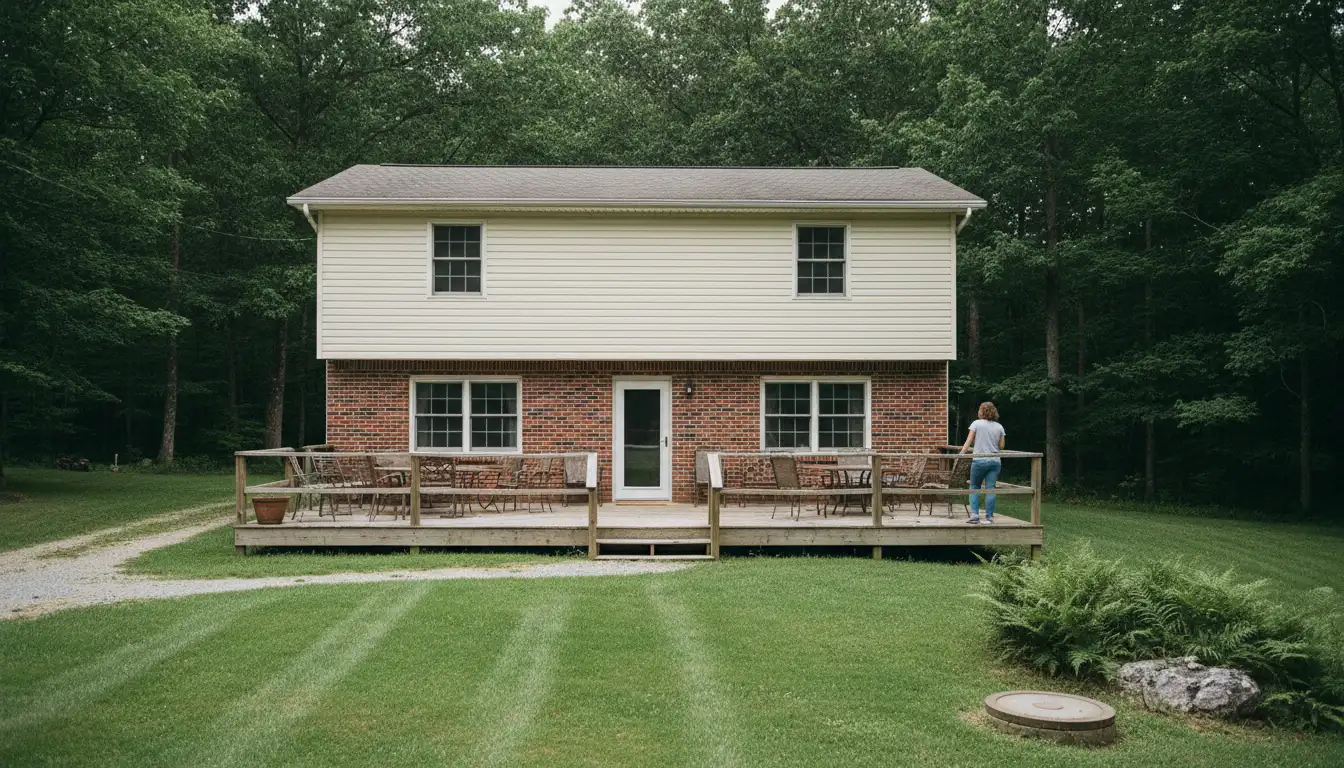
Short-Term Rental Septic Service in Nashville, TN

A septic system is permitted for a bedroom count, not a guest count. Nashville short-term rentals load systems in ways the original design never assumed.

from $400

$325–$550 per service, on intervals substantially shorter than an owner-occupied home

Short-Term Rental Septic Service in Nashville, TN
  • Tenn. Comp. R. & Regs. 0400-48-01-.20 governs septic pumping contractors
  • Davidson County administers its own septic program as a TDEC contract county
  • Tennessee guidance: pump every 3–5 years
  • Grease traps serviced every 30 days · interceptors every 90
  • Sludge and scum depth recorded on every visit

Last updated: August 31, 2026

615 Septic Tank Pumping is a septic tank pumping company serving Nashville and Davidson County, Tennessee, and short-term rental septic service is one of the services it provides across the county. A septic system is permitted for a bedroom count, not a guest count. Nashville short-term rentals load systems in ways the original design never assumed.

When people call us about this

These are the situations that bring most short-term rental septic service calls in:

  • A listing sleeping more guests than the house has bedrooms
  • Slow drains appearing on peak weekends and clearing midweek
  • Odour reported in guest reviews
  • No idea what bedroom count the system was permitted for
  • A system pumped on an owner-occupied interval but run at STR occupancy

What is included

Every short-term rental septic service job includes all of the following. Nothing on this list is an upsell presented once we are on site.

  • Metro bedroom-approval record retrieved for the property
  • Permitted bedroom count compared against the listing's advertised sleeping capacity
  • Tank capacity assessed against realistic peak-weekend loading
  • Full pump-out with baffles and filter inspected
  • Service interval built around booking patterns rather than a calendar
  • Scheduling into turnover gaps so guest stays are unaffected
  • Written record for your file and your property manager
  • Plain advice where the system is genuinely undersized for how you are letting it

What it costs, and what moves the price

The pumping is priced normally; the difference is frequency. An STR at high occupancy can need service two to four times as often as the same house lived in by a family.

The published range for this service is $325–$550 per service, on intervals substantially shorter than an owner-occupied home. We give you a band before we come out and a firm number before we do anything that changes it. If you want a figure right now without talking to anyone, the cost estimator takes three questions.

How short-term rental septic service runs, start to finish

  1. 01

    Pull the permitted bedroom count

    Metro holds the approval record — the bedroom count your system was actually sized and permitted for. Everything else follows from that number.

  2. 02

    Compare it to the listing

    A three-bedroom-approved system in a house advertised as sleeping ten is loaded at several times its design flow on a peak weekend. That is a capacity problem, and no pumping schedule fixes it.

  3. 03

    Service into the turnover gap

    We schedule between bookings. A tank pumped during a changeover costs you nothing in occupancy.

  4. 04

    Set the interval to the bookings

    Interval comes off actual occupancy, not the calendar. A heavily booked STR may need service several times a year where the same house lived in by a family would go three.

Doing it yourself, hiring cheap, and doing it properly

The difference between a cheap pump-out and a proper one is not the truck. It is whether anybody looked inside the tank while it was empty.

  Doing it yourself Cheapest quote Done properly
Solids actually removed Surface liquid only — no way to remove settled sludge Liquid draw-down; tank looks emptied, sludge stays Liquid, scum and sludge pumped, then backflushed
Baffles inspected Not visible without emptying the tank Rarely — the tank is not pumped down far enough to see them Both baffles inspected while the tank is empty, and reported
Effluent filter Usually not known to exist Left alone Removed, rinsed back into the tank, inspected, replaced if split
Interval set by Guesswork or a number off the internet A flat three years for every customer Measured sludge and scum depth against your tank capacity
Disposal of septage No lawful route for a homeowner Varies — ask where it goes Licensed disposal under Tennessee pumping contractor rules
What it costs Nothing up front Slightly less than proper $300–$525 typical
What it risks Solids reach the drain field. Field replacement $7,000–$15,000+ Same failure, delayed. The field pays for the saving The field is what you are protecting

Worth reading before you book

Need short-term rental septic service in Nashville?

Call for a price, or use the estimator if you would rather not talk to anyone yet.

Short-Term Rental Septic Service — questions people ask

Is my septic system big enough for a short-term rental?

It was sized for a permitted bedroom count, and Metro Public Health will tell you what that number is. If your listing sleeps meaningfully more people than the system was approved for, you are running it above design flow — which shows up first as weekend slow drains and eventually as a drain field that stops accepting. The bedroom count is the number that matters, not the square footage.

Can I advertise more guests than my septic is approved for?

Tread carefully. In Tennessee it is illegal to advertise a home for more bedrooms than its septic is approved for, and whoever advertises it is liable for misrepresentation. That rule is usually discussed in the context of home sales, but the wording is about advertising, and a short-term rental listing is advertising. Get the permitted count, and take advice before listing above it.

How often should an STR septic tank be pumped?

Considerably more often than an owner-occupied home — two to four times as often is common at high occupancy. Guest use is also harder on a system than family use: more laundry per night, more simultaneous showers, and wipes and grease that a household would not put down its own drain.

My guests overloaded the system — what now?

Stop water use, get the tank pumped down, and have the cause diagnosed rather than assuming it was a one-off. Repeated overloading damages the drain field, and a field replacement in Middle Tennessee runs $7,000–$15,000 and up. If the underlying issue is that occupancy exceeds the permitted design, pumping is a holding action, not a solution.

How do you price the work, and will the price change once you are here?

You get a range before we come out, based on your tank size and how buried the lids are. Tennessee pumping runs $275–$525 and Davidson County figures span $199–$796, so the honest answer is that access and capacity move it. If we open the tank and find something that changes the job — compacted sludge needing a clean, a corroded baffle, a split effluent filter — we tell you what it costs and let you decide before we do it. We do not do the work and present the bill afterwards.

Related services

Call (615) 234-9048 — a person answers