Last updated: 2026-08-16
615 Septic Tank Pumping is a licensed emergency septic contractor serving Nashville and Davidson County. Sewage inside a home is a health emergency, not a plumbing inconvenience — raw sewage carries bacteria and pathogens that make the affected area genuinely unsafe until it is cleared and disinfected.
What happens on the first visit
A first call for emergency septic service in Nashville starts with the four stages below. Nothing is fitted, dug or replaced without being quoted first, and the price is confirmed before work begins.
-
Call and describe what is happening
Where the sewage is appearing, when it started, and whether water is still being used in the house. Stop using water if backup is active.
-
Pump down first
The tank is drawn down immediately to relieve pressure on the building drain and stop the backup progressing.
-
Find the actual cause
A full tank is the common cause but not the only one. Baffle failure, a blocked effluent filter, a collapsed inlet line and a saturated field all present the same way.
-
Written findings and next step
What failed, whether the system is usable, and what the repair path is — in writing, the same visit.
What to do in the first ten minutes
Stop adding water. Every flush, every load of laundry, every shower pushes more volume into a system that has already run out of somewhere to put it. This single step does more to limit damage than anything else available to a homeowner.
Keep people and pets away from the affected area. Do not attempt to open the tank lid — septic tank gases displace oxygen and have killed people who leaned in. If sewage has reached living space, the area needs professional cleaning and disinfection after the system is cleared, not just a mop.
A full tank is the likely cause, not the only one
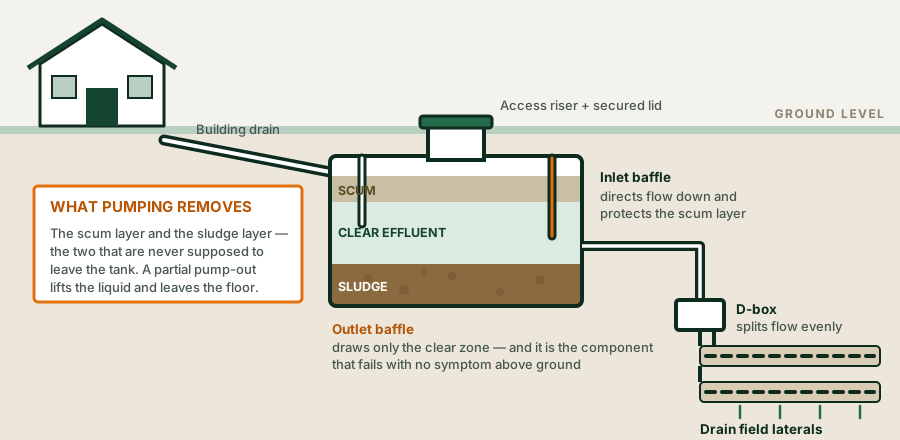
Pumping down relieves the immediate emergency in most cases, because a full tank is the most common reason a system stops accepting water. But an identical presentation comes from a blocked effluent filter, a failed outlet baffle dropping solids into the field, a collapsed line between house and tank, or a drain field that has reached the end of its life.
Pumping a tank whose drain field has failed buys days, not years — the tank simply refills from the house with nowhere for the effluent to go. Knowing which situation is in play changes what the homeowner should spend money on next, so the diagnosis matters as much as the pump-out.
Wet weather, karst ground and the Middle Tennessee failure pattern
Davidson County sits on fractured limestone with a thin, clay-heavy soil mantle. After sustained rain, the soil around a drain field saturates and its capacity to accept effluent drops sharply — which is why a marginal system that coped all summer backs up during a wet week in spring.
A system that only backs up in wet weather is telling you something specific: the tank may be fine and the field is at its limit. That distinction is worth having in writing before anyone quotes a replacement.
When this service is the right call
The signals below are the ones that bring most Nashville properties to this service. Any one of them is worth a call; several together usually mean the system is already past the point where waiting is cheap.
- Sewage backing up through a floor drain, tub or lowest toilet
- Standing effluent or wet, dark ground over the drain field
- Sewage odour strong enough to notice indoors
- Every drain in the house slow at the same time
- Alarm sounding on a pump tank or aerobic unit
What is included
Every emergency septic service visit covers all eight of these. They are not tiers or add-ons — the list is what the job is.
- Priority dispatch ahead of the scheduled queue
- Immediate pump-down to take pressure off the house
- Diagnosis of cause — full tank, blocked filter, failed baffle, or field failure
- Check for a blocked outlet or collapsed line between house and tank
- Written statement of what failed, for insurance purposes
- Advice on what is safe to use in the house before and after
- Referral where the fault is in the building drain rather than the system
- Follow-up interval set so the same failure does not repeat
Paying for it, and what the alternative costs
Emergency response is quoted on the call; after-hours and access conditions drive the difference from a scheduled visit.
For scale: a drain field replacement in Middle Tennessee is commonly quoted at $6,000 to $10,000, against published 2026 national figures of roughly $5,000 to $20,000. The whole economic case for maintaining a septic system is the gap between those two numbers. Pricing here is confirmed on site before work starts, and the cost estimator shows the full formula rather than asking for contact details first.
Doing it properly versus doing it cheaply
The invoice for a thorough job and a rushed one look similar. What separates them is whether the tank was emptied to the floor, whether anyone looked at the baffles while it was open, and whether the property owner ends up knowing anything they did not know before.
| What matters | Do nothing / DIY | Cheapest quote | Done properly |
|---|---|---|---|
| What leaves the tank | Not achievable — domestic septage removal requires a permitted hauler and a licensed disposal site. | Liquid drawn off; compacted sludge on the floor usually stays. | Liquid, scum and sludge removed to a visible tank floor. |
| Baffle inspection | None. Opening a tank is a confined-space hazard. | Rarely — the tank is often not emptied enough to see them. | Inlet and outlet checked with the tank empty, photographed. |
| Effluent filter | Usually unknown to the owner. | Commonly missed; a blocked filter mimics a full tank. | Located, rinsed, condition recorded. |
| What you know afterwards | Nothing new. | That it was pumped. No readings, no interval. | Sludge depth, component condition, and a dated next-service interval. |
| Effect on the drain field | Continues to degrade. | Working volume only partly restored — symptoms often return within months. | Full working volume restored; solids stop reaching the field. |
| Typical cost | $0 upfront, against a $6,000–$10,000 drain field replacement. | At or below the $275 low end, repeated more often. | $275–$525 on a 3–5 year interval. |
| Paper trail | None. | An invoice. | Dated findings for insurance, a sale, or the next inspection. |
Related resources
- What To Do Now
Sewage Is Backing Up Into My House. What Do I Do?
The first ten minutes matter more than anything that happens afterwards. Here is the order to do things in.
Read the guide
- What To Do Now
My Septic Tank Is Overflowing. Is This an Emergency?
Overflow above ground and backup inside the house are the same failure showing itself in two directions. Both need the same first move.
Read the guide
- Rules & Permits
Does Homeowners Insurance Cover Septic System Failure?
The answer turns on one distinction insurers apply consistently — and on whether you can prove which side of it you are on.
Read the guide
- What To Do Now
What Are the Signs a Septic Tank Needs Pumping?
Six signals, ranked from watch-it to stop-using-water. Most of them mean the same thing, and the ranking is about how much time you have.
Read the guide
Frequently asked questions
Is sewage in the house dangerous?
Yes. Raw sewage carries bacteria, viruses and parasites. Keep people and pets out of the affected area, do not use the space until it has been cleared and disinfected, and wash thoroughly after any contact.
Should water use stop before the truck arrives?
Yes, completely. No flushing, no laundry, no dishwasher, no showers. Every gallon added makes the backup worse and increases what ends up inside the building.
Will pumping fix the problem permanently?
It fixes it permanently when the cause was simply a full tank. It buys days when the drain field has failed. The visit includes finding out which of those applies, in writing.
Does homeowner's insurance cover this?
Policies vary widely. Sudden and accidental backup is often covered under a rider; gradual failure from missed maintenance usually is not. The written findings from the visit are what the claim is assessed against, which is why they are provided.
What area does 615 Septic Tank Pumping cover?
Nashville and Davidson County, including Bellevue, Antioch, Hermitage, Donelson, Madison, Green Hills, Goodlettsville, Old Hickory, Joelton and the surrounding Middle Tennessee area. Call to confirm coverage for a specific address.