Last updated: 2026-08-16
615 Septic Tank Pumping is a licensed septic tank pumping contractor serving Nashville and Davidson County. Residential pumping is the core of the work: the tank is emptied completely — liquids and the settled sludge layer both — the inlet and outlet baffles are inspected while the tank is open, and the household leaves the visit with a specific interval rather than a guess.
What happens on the first visit
A first call for residential septic tank pumping in Nashville starts with the four stages below. Nothing is fitted, dug or replaced without being quoted first, and the price is confirmed before work begins.
-
Call and describe the situation
Address, approximate tank size if known, and any symptoms. Unknown tank size is normal — the technician measures on arrival.
-
Access is located and opened
The lid is uncovered. On lots with no riser, a short excavation over the access port may be needed; that is discussed before it happens.
-
The tank is pumped and inspected
Liquid, scum and sludge are removed to the tank floor. Baffles, walls and lid are checked with the tank empty.
-
Findings and interval delivered
What was found, what it means, and the date the next pump-out is due — before the truck leaves the property.
What a full pump-out actually removes
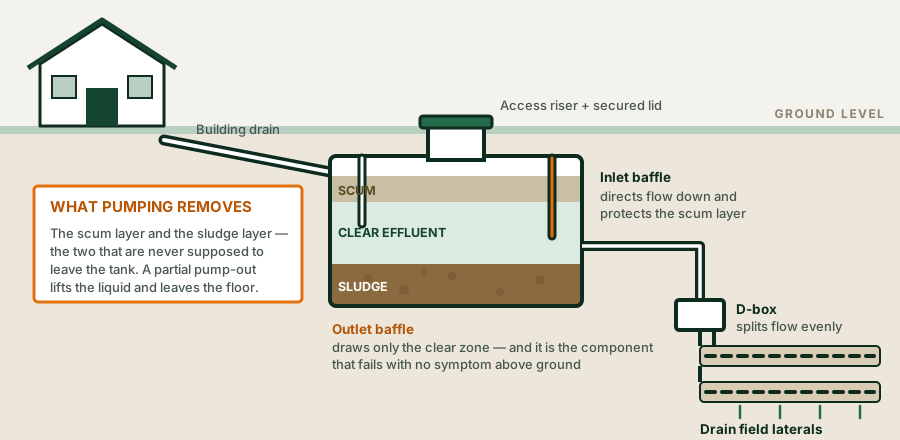
A septic tank separates household wastewater into three layers: scum floating on top, relatively clear effluent in the middle, and sludge settled on the floor. Only the middle layer is supposed to leave the tank, through the outlet baffle and into the drain field. Pumping is the removal of the two layers that are not supposed to leave.
A partial pump-out that draws off liquid and leaves the sludge behind looks identical from the surface and costs the same in labour. It is the single most common shortcut in this trade. A complete pump-out ends with the operator able to see the tank floor, and the sludge depth measured before pumping is what the next interval is calculated from.
Why the drain field is the real asset being protected
The drain field is the buried network of perforated pipe and aggregate that returns treated effluent to the soil. It is not serviceable in the way a tank is. Once solids escape the tank and reach the field, they blind the soil interface, and the fix is replacement rather than repair.
Published 2026 replacement figures put a drain field at roughly $5,000 to $20,000 nationally, with Middle Tennessee jobs commonly quoted at $6,000 to $10,000 depending on size, soil and access. A pump-out at $275 to $525 every three to five years is the maintenance that keeps that number theoretical.
Tank capacity, household size, and the interval that follows from them
Tennessee sizes tanks by bedroom count under the state's private sewage disposal code, with 750 gallons as the floor and 1,000 to 1,500 gallons covering most single-family homes. Capacity is only half the equation; the other half is how much wastewater the household actually produces.
A 1,000-gallon tank serving four people accumulates sludge roughly twice as fast as the same tank serving two. Garbage disposals, water softener discharge and heavy laundry days all shorten the interval. The three-to-five-year rule of thumb is a starting point; the measured sludge depth at the last visit is the real number.
When this service is the right call
The signals below are the ones that bring most Nashville properties to this service. Any one of them is worth a call; several together usually mean the system is already past the point where waiting is cheap.
- Toilets flushing slowly or gurgling in more than one bathroom
- Sewage odor at the drains or over the tank
- Wet, spongy grass above the drain field in dry weather
- More than five years since the last documented pump-out
- No record at all of when the tank was last serviced
What is included
Every residential septic tank pumping visit covers all eight of these. They are not tiers or add-ons — the list is what the job is.
- Locating and exposing the tank access lid
- Full removal of liquid, scum layer and settled sludge
- Visual inspection of the inlet and outlet baffles
- Check of the tank walls and lid for cracks or root intrusion
- Liquid-level reading taken before pumping to gauge accumulation rate
- Backflush of the tank interior so the sludge line is visible
- Plain-language findings, spoken and written
- A pumping interval calculated from tank capacity and household size
Paying for it, and what the alternative costs
Published Tennessee pumping range, $275–$525 per visit (SepticCompaniesNearMe 2026 state data; Davidson County jobs reported $199–$796 depending on tank size and access).
For scale: a drain field replacement in Middle Tennessee is commonly quoted at $6,000 to $10,000, against published 2026 national figures of roughly $5,000 to $20,000. The whole economic case for maintaining a septic system is the gap between those two numbers. Pricing here is confirmed on site before work starts, and the cost estimator shows the full formula rather than asking for contact details first.
Doing it properly versus doing it cheaply
The invoice for a thorough job and a rushed one look similar. What separates them is whether the tank was emptied to the floor, whether anyone looked at the baffles while it was open, and whether the property owner ends up knowing anything they did not know before.
| What matters | Do nothing / DIY | Cheapest quote | Done properly |
|---|---|---|---|
| What leaves the tank | Not achievable — domestic septage removal requires a permitted hauler and a licensed disposal site. | Liquid drawn off; compacted sludge on the floor usually stays. | Liquid, scum and sludge removed to a visible tank floor. |
| Baffle inspection | None. Opening a tank is a confined-space hazard. | Rarely — the tank is often not emptied enough to see them. | Inlet and outlet checked with the tank empty, photographed. |
| Effluent filter | Usually unknown to the owner. | Commonly missed; a blocked filter mimics a full tank. | Located, rinsed, condition recorded. |
| What you know afterwards | Nothing new. | That it was pumped. No readings, no interval. | Sludge depth, component condition, and a dated next-service interval. |
| Effect on the drain field | Continues to degrade. | Working volume only partly restored — symptoms often return within months. | Full working volume restored; solids stop reaching the field. |
| Typical cost | $0 upfront, against a $6,000–$10,000 drain field replacement. | At or below the $275 low end, repeated more often. | $275–$525 on a 3–5 year interval. |
| Paper trail | None. | An invoice. | Dated findings for insurance, a sale, or the next inspection. |
Related resources
- Cost Guide
What a Standard Pump-Out Costs in Nashville
The published range, the four things that actually move it, and the point at which a pump-out stops being a pump-out and becomes a clean-out.
Read the guide
- Decision Guide
How Often Should a Nashville Tank Be Emptied?
Three to five years is the rule of thumb. Here is what actually decides where a specific Nashville system falls in that range — and how to replace the guess with a date.
Read the guide
- What To Do Now
What Are the Signs a Septic Tank Needs Pumping?
Six signals, ranked from watch-it to stop-using-water. Most of them mean the same thing, and the ranking is about how much time you have.
Read the guide
- Decision Guide
Septic Tank Pumping vs Cleaning: What Is the Difference?
The two words get used interchangeably by companies that only do one of them. The difference is what is left on the tank floor.
Read the guide
Frequently asked questions
How long does a residential pump-out take?
One to two hours for a typical 1,000 to 1,500 gallon tank with accessible lid. Tanks that need the access port uncovered, or that have not been serviced in a decade, run longer.
Does the yard get torn up?
No. A truck parks on the drive or a firm verge and the hose is run to the tank. Where the lid is buried, a small area of turf over the access port is lifted and replaced. Nothing else is disturbed.
Does the tank need to be pumped if there are no symptoms?
Yes. By the time symptoms appear, solids have usually already begun moving toward the drain field. Pumping on schedule is preventive; pumping on symptoms is damage control.
Is the water usable during the service?
Hold off on running water and flushing while the tank is open, roughly one to two hours. Normal use resumes as soon as the lid is back on.
What area does 615 Septic Tank Pumping cover?
Nashville and Davidson County, including Bellevue, Antioch, Hermitage, Donelson, Madison, Green Hills, Goodlettsville, Old Hickory, Joelton and the surrounding Middle Tennessee area. Call to confirm coverage for a specific address.