Last updated: 2026-08-16
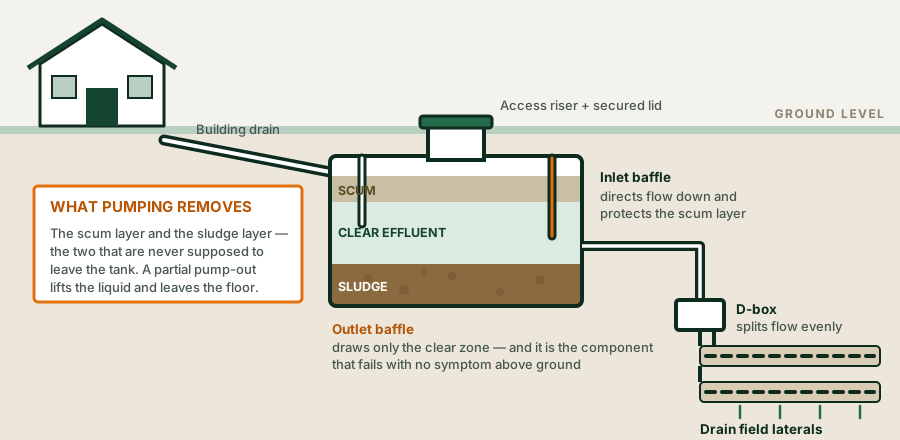
615 Septic Tank Pumping is a licensed septic service provider in Nashville, TN. A riser is a short section of pipe that carries the tank's access port from wherever it sits underground up to ground level, finished with a sealed, secured lid. It is the single cheapest change that makes a septic system easier to look after.
What happens on the first visit
A first call for septic tank riser installation in Nashville starts with the four stages below. Nothing is fitted, dug or replaced without being quoted first, and the price is confirmed before work begins.
-
Expose the port
The access port is uncovered and the tank surface cleaned so the riser seats on sound concrete.
-
Size the riser
Height is measured to finished grade, allowing for the lid to sit slightly proud rather than in a hollow.
-
Seat and seal
The riser is bonded to the tank and the joint sealed against surface water — a leaking riser is worse than no riser.
-
Reinstate and secure
Backfill, surface made good, and a secured lid fitted. Loose lids are not acceptable on an at-grade access port.
The lid has to be secured, not just present
Bringing an access port to the surface creates a hazard that did not exist while it was buried. A septic tank is a confined space with an oxygen-displacing atmosphere, and there is a real history of children and animals falling into tanks through unsecured lids.
Every riser fitted here gets a lid that is bolted or twist-locked and rated to be walked on. This is not a preference; it is the condition on which bringing the port to grade is a good idea at all.
Sealing matters as much as height
An unsealed riser turns the access port into a surface water inlet. Rain running across the lawn enters the tank, displaces working volume, and pushes hydraulic load onto the drain field it was never meant to carry.
The joint between riser and tank is sealed, and the lid is set slightly proud of the surrounding grade so water sheds away rather than pooling on it. On the clay soils across Davidson County, where surface water sits rather than soaking away, that detail earns its keep every spring.
What it changes about owning the system
With a riser fitted, a pump-out is a truck, a hose and an hour. Without one, every visit starts with locating and excavating, and that cost and hassle is exactly what makes owners defer service past the interval.
It also makes small things practical: rinsing an effluent filter between services, checking sludge depth, and showing a buyer's inspector the tank interior without booking an excavation.
When this service is the right call
The signals below are the ones that bring most Nashville properties to this service. Any one of them is worth a call; several together usually mean the system is already past the point where waiting is cheap.
- The access lid buried under six inches or more of soil
- An excavation charge on every service invoice
- A tank that had to be located by probing on the last visit
- An effluent filter that should be rinsed between services
- A property being prepared for sale or handover
What is included
Every septic tank riser installation visit covers all eight of these. They are not tiers or add-ons — the list is what the job is.
- Access port excavated and cleaned back to the tank surface
- Riser section sized to bring the port to finished grade
- Sealed joint between riser and tank
- Secured lid — bolted or twist-lock, not a loose slab
- Backfill and reinstatement around the riser
- Turf or surface finish made good
- Lid set slightly proud so mowers clear it and surface water sheds away
- Position recorded in the service record
Paying for it, and what the alternative costs
Priced by riser height and lid diameter; quoted on site once the port depth is known.
For scale: a drain field replacement in Middle Tennessee is commonly quoted at $6,000 to $10,000, against published 2026 national figures of roughly $5,000 to $20,000. The whole economic case for maintaining a septic system is the gap between those two numbers. Pricing here is confirmed on site before work starts, and the cost estimator shows the full formula rather than asking for contact details first.
Doing it properly versus doing it cheaply
The invoice for a thorough job and a rushed one look similar. What separates them is whether the tank was emptied to the floor, whether anyone looked at the baffles while it was open, and whether the property owner ends up knowing anything they did not know before.
| What matters | Do nothing / DIY | Cheapest quote | Done properly |
|---|---|---|---|
| What leaves the tank | Not achievable — domestic septage removal requires a permitted hauler and a licensed disposal site. | Liquid drawn off; compacted sludge on the floor usually stays. | Liquid, scum and sludge removed to a visible tank floor. |
| Baffle inspection | None. Opening a tank is a confined-space hazard. | Rarely — the tank is often not emptied enough to see them. | Inlet and outlet checked with the tank empty, photographed. |
| Effluent filter | Usually unknown to the owner. | Commonly missed; a blocked filter mimics a full tank. | Located, rinsed, condition recorded. |
| What you know afterwards | Nothing new. | That it was pumped. No readings, no interval. | Sludge depth, component condition, and a dated next-service interval. |
| Effect on the drain field | Continues to degrade. | Working volume only partly restored — symptoms often return within months. | Full working volume restored; solids stop reaching the field. |
| Typical cost | $0 upfront, against a $6,000–$10,000 drain field replacement. | At or below the $275 low end, repeated more often. | $275–$525 on a 3–5 year interval. |
| Paper trail | None. | An invoice. | Dated findings for insurance, a sale, or the next inspection. |
Related resources
- Decision Guide
How Do I Find Where My Septic Tank Is Buried?
Records first, ground second, shovel last. Done in that order most Davidson County tanks are found in under an hour with almost no disturbance.
Read the guide
- Cost Guide
What a Standard Pump-Out Costs in Nashville
The published range, the four things that actually move it, and the point at which a pump-out stops being a pump-out and becomes a clean-out.
Read the guide
Frequently asked questions
How much does a riser save on future service?
It removes the locate-and-excavate portion of every subsequent visit. On a tank that currently needs digging out each time, it typically pays for itself across two or three services.
Can a riser be fitted during a pump-out?
Yes, and that is the efficient way to do it — the port is already exposed and the tank is already empty. It is quoted before the work starts.
Is the lid safe with children or pets in the yard?
The lids fitted here are secured — bolted or twist-lock — and rated for foot traffic. An at-grade access port with a loose lid is genuinely dangerous, and that is not what gets installed.
Will it be visible in the lawn?
Yes, as a green or black lid roughly the diameter of the access port, set slightly above grade so a mower passes over it and water sheds off. Most owners consider that a reasonable trade for never digging again.
What area does 615 Septic Tank Pumping cover?
Nashville and Davidson County, including Bellevue, Antioch, Hermitage, Donelson, Madison, Green Hills, Goodlettsville, Old Hickory, Joelton and the surrounding Middle Tennessee area. Call to confirm coverage for a specific address.