Last updated: 2026-08-16
615 Septic Tank Pumping is a licensed commercial septic contractor serving Nashville and Davidson County. Commercial systems fail differently from residential ones: the flow is concentrated into operating hours, the waste stream carries grease and cleaning chemistry, and a failure closes a business rather than inconveniencing a family.
What happens on the first visit
A first call for commercial septic pumping in Nashville starts with the four stages below. Nothing is fitted, dug or replaced without being quoted first, and the price is confirmed before work begins.
-
Site survey
Tank count, capacity, interceptor presence, access route for the truck, and the occupancy the system is actually carrying.
-
Interval set from flow
Estimated daily flow against working capacity produces a service interval — commonly annual, quarterly for food service.
-
Service outside trading hours
Pump-out and inspection scheduled around opening times so the business stays open.
-
Documentation filed
Volume, date, findings and disposal manifest go into the site's maintenance record.
Commercial flow is peaky, and that changes the sizing maths
A house spreads its wastewater over the whole day. A restaurant, a church or an office concentrates it into a few hours. The same daily volume arriving in a three-hour window gives solids far less settling time inside the tank, and more of them leave with the effluent.
That is why a commercial tank on a residential three-to-five-year interval fails early. The interval here is set from estimated daily flow against working capacity, not from a bedroom count.
Grease, chemistry and what the tank is actually receiving
Commercial waste streams carry things a household stream does not: fats from food prep, sanitiser and degreaser from cleaning routines, and in some trades solvents that were never meant to reach a biological system.
Degreasers are the quiet problem. They do exactly what the label says — emulsify grease so it flows — which means grease that should have been trapped in the interceptor passes through and re-solidifies in the tank and the field instead. Where a site uses them, interceptor service moves to a shorter interval.
Records are the deliverable, not just the pump-out
For a commercial site the maintenance record has value independent of the service. It is what an inspector asks for, what an insurer asks for after a loss, and what a buyer's surveyor asks for at sale.
Every commercial visit produces a dated record: volume removed, condition of tank and baffles, filter service, and the disposal manifest. Tennessee requires permitted haulers to identify their vehicles with the firm name, address and domestic septage removal permit number in two-inch lettering — that permit number appears on the paperwork too.
When this service is the right call
The signals below are the ones that bring most Nashville properties to this service. Any one of them is worth a call; several together usually mean the system is already past the point where waiting is cheap.
- Floor drains backing up during peak service hours
- Odour reported by staff or customers near the service yard
- A system sized for a previous tenant with a different occupancy
- An inspection or health department visit scheduled
- No maintenance record on file for the site
What is included
Every commercial septic pumping visit covers all eight of these. They are not tiers or add-ons — the list is what the job is.
- Flow-based interval calculation rather than a residential rule of thumb
- Full pump-out of tank and any interceptor in the run
- Baffle, tee and access-riser inspection
- Effluent filter service where fitted
- Manifest documentation of volume removed and disposal site
- Dated service record suitable for health department review
- Off-hours scheduling so trading is not interrupted
- Standing schedule set for the following service
Paying for it, and what the alternative costs
Commercial pricing is volume- and access-driven and is quoted per site rather than from a published band.
For scale: a drain field replacement in Middle Tennessee is commonly quoted at $6,000 to $10,000, against published 2026 national figures of roughly $5,000 to $20,000. The whole economic case for maintaining a septic system is the gap between those two numbers. Pricing here is confirmed on site before work starts, and the cost estimator shows the full formula rather than asking for contact details first.
Doing it properly versus doing it cheaply
The invoice for a thorough job and a rushed one look similar. What separates them is whether the tank was emptied to the floor, whether anyone looked at the baffles while it was open, and whether the property owner ends up knowing anything they did not know before.
| What matters | Do nothing / DIY | Cheapest quote | Done properly |
|---|---|---|---|
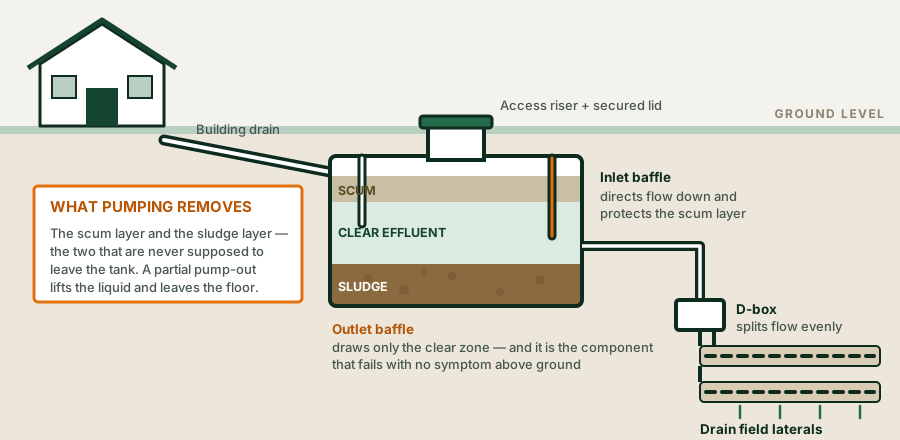
| What leaves the tank | Not achievable — domestic septage removal requires a permitted hauler and a licensed disposal site. | Liquid drawn off; compacted sludge on the floor usually stays. | Liquid, scum and sludge removed to a visible tank floor. |
| Baffle inspection | None. Opening a tank is a confined-space hazard. | Rarely — the tank is often not emptied enough to see them. | Inlet and outlet checked with the tank empty, photographed. |
| Effluent filter | Usually unknown to the owner. | Commonly missed; a blocked filter mimics a full tank. | Located, rinsed, condition recorded. |
| What you know afterwards | Nothing new. | That it was pumped. No readings, no interval. | Sludge depth, component condition, and a dated next-service interval. |
| Effect on the drain field | Continues to degrade. | Working volume only partly restored — symptoms often return within months. | Full working volume restored; solids stop reaching the field. |
| Typical cost | $0 upfront, against a $6,000–$10,000 drain field replacement. | At or below the $275 low end, repeated more often. | $275–$525 on a 3–5 year interval. |
| Paper trail | None. | An invoice. | Dated findings for insurance, a sale, or the next inspection. |
Related resources
- Cost Guide
How Much Does Grease Trap Cleaning Cost in Nashville?
Priced by capacity and interval rather than from a published band — and the interval is the part most kitchens get wrong.
Read the guide
- Rules & Permits
What Do Tennessee Septic Regulations Require of Homeowners?
The parts of Chapter 0400-48-01 that actually affect a homeowner, in plain terms, with the rule numbers so you can check them.
Read the guide
- Cost Guide
How Much Does a Septic Tank Inspection Cost in Nashville?
Inspection is priced against pumping for one reason: almost nothing worth finding is visible until the tank is empty.
Read the guide
Frequently asked questions
How often does a commercial system need service?
It depends on flow. Offices and churches often run annually. Food service, with an interceptor in the run, is commonly quarterly. The interval is calculated from the site's estimated daily flow against working tank capacity.
Can service happen outside business hours?
Yes, and for most sites it should. Early morning and after-close slots are standard for commercial work so trading is not affected.
Is the disposal documented?
Yes. Volume removed, date, and the permitted disposal site are recorded on the manifest and filed with the site's service record.
What happens if the tank was sized for a previous tenant?
The survey catches it. An undersized tank for the current occupancy is managed with a shorter interval until it can be upsized, and that constraint is put in writing so it is not a surprise later.
What area does 615 Septic Tank Pumping cover?
Nashville and Davidson County, including Bellevue, Antioch, Hermitage, Donelson, Madison, Green Hills, Goodlettsville, Old Hickory, Joelton and the surrounding Middle Tennessee area. Call to confirm coverage for a specific address.