Last updated: 2026-08-16
615 Septic Tank Pumping is a licensed septic service provider working with Nashville landlords and property managers. A septic failure at a rental is not the same problem as a septic failure at an owner-occupied home: the property becomes uninhabitable, the tenant relationship takes the damage, and the liability sits with the owner regardless of what caused it.
What happens on the first visit
A first call for rental property septic pumping in Nashville starts with the four stages below. Nothing is fitted, dug or replaced without being quoted first, and the price is confirmed before work begins.
-
Portfolio intake
Addresses, tank capacities where known, occupancy, and any known history. Unknowns are established at the first visit.
-
Schedule set per property
Occupancy-driven intervals, with vacancy windows used where turnover timing allows.
-
Service with tenant coordination
Access arranged with the tenant directly so the manager is not relaying appointment times.
-
Records filed by address
Each property accumulates a dated service history, which is what an insurer or a buyer asks for later.
Rental systems fail earlier, and the reason is usage
The occupant of a rental has no financial stake in the drain field. Wipes get flushed, grease goes down the sink, and nobody is measuring sludge depth. That is not a character judgement, it is an incentive structure, and it shows up in the tank.
The practical response is a shorter interval than an owner-occupied property of the same size, plus a plain-language note in the tenancy paperwork about what the system cannot take. Both are cheaper than the failure they prevent.
Turnover is the window worth using
Between tenancies the property is empty, access is unrestricted, and there is no one to inconvenience. It is the ideal time to pump, inspect, and fit a riser if one is missing.
It also produces a documented condition at a known date, which is the reference point if a subsequent tenancy causes damage. Landlords who service at every turnover rarely have the argument about who caused what.
Liability, habitability and the documented history
A sewage backup at a rental engages habitability obligations quickly, and an emergency repair happens at emergency prices with a displaced tenant attached. The insurance question that follows is almost always whether the failure was sudden or the result of deferred maintenance.
A dated service history per address is what settles that question. It is the reason the records here are kept per property rather than per invoice, and it is available whenever the portfolio is refinanced or sold.
When this service is the right call
The signals below are the ones that bring most Nashville properties to this service. Any one of them is worth a call; several together usually mean the system is already past the point where waiting is cheap.
- A portfolio with no consolidated maintenance record
- Properties inherited with unknown service history
- Turnover between tenants — the natural service window
- A tenant reporting slow drains or odour
- Budgeting that treats septic as an emergency line rather than a scheduled one
What is included
Every rental property septic pumping visit covers all eight of these. They are not tiers or add-ons — the list is what the job is.
- Service schedule set per address from tank capacity and occupancy
- Tenant contact and access coordination handled directly
- Full pump-out with baffle and filter inspection at each visit
- Condition report filed per address, building a history over time
- Turnover-window scheduling between tenancies
- Consolidated invoicing across a portfolio
- Flagging of tenant-usage issues found in the tank
- Written record available for insurance or a future sale
Paying for it, and what the alternative costs
Portfolio pricing is set per property count and interval; quoted directly.
For scale: a drain field replacement in Middle Tennessee is commonly quoted at $6,000 to $10,000, against published 2026 national figures of roughly $5,000 to $20,000. The whole economic case for maintaining a septic system is the gap between those two numbers. Pricing here is confirmed on site before work starts, and the cost estimator shows the full formula rather than asking for contact details first.
Doing it properly versus doing it cheaply
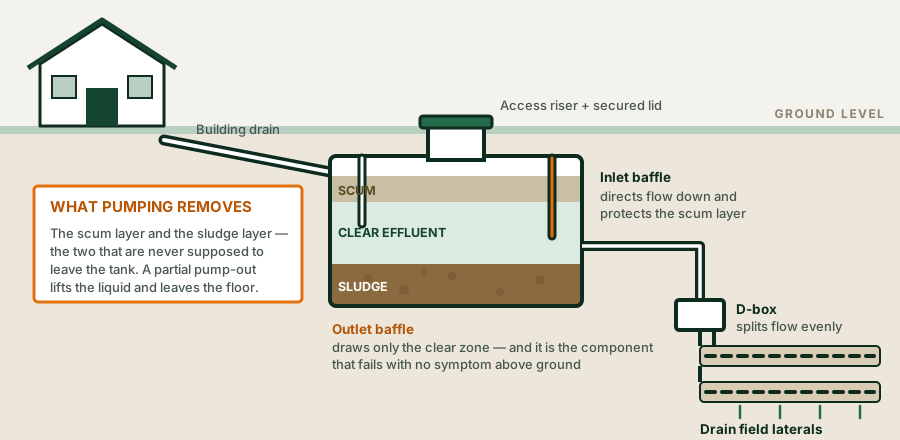
The invoice for a thorough job and a rushed one look similar. What separates them is whether the tank was emptied to the floor, whether anyone looked at the baffles while it was open, and whether the property owner ends up knowing anything they did not know before.
| What matters | Do nothing / DIY | Cheapest quote | Done properly |
|---|---|---|---|
| What leaves the tank | Not achievable — domestic septage removal requires a permitted hauler and a licensed disposal site. | Liquid drawn off; compacted sludge on the floor usually stays. | Liquid, scum and sludge removed to a visible tank floor. |
| Baffle inspection | None. Opening a tank is a confined-space hazard. | Rarely — the tank is often not emptied enough to see them. | Inlet and outlet checked with the tank empty, photographed. |
| Effluent filter | Usually unknown to the owner. | Commonly missed; a blocked filter mimics a full tank. | Located, rinsed, condition recorded. |
| What you know afterwards | Nothing new. | That it was pumped. No readings, no interval. | Sludge depth, component condition, and a dated next-service interval. |
| Effect on the drain field | Continues to degrade. | Working volume only partly restored — symptoms often return within months. | Full working volume restored; solids stop reaching the field. |
| Typical cost | $0 upfront, against a $6,000–$10,000 drain field replacement. | At or below the $275 low end, repeated more often. | $275–$525 on a 3–5 year interval. |
| Paper trail | None. | An invoice. | Dated findings for insurance, a sale, or the next inspection. |
Related resources
- Rules & Permits
Does Homeowners Insurance Cover Septic System Failure?
The answer turns on one distinction insurers apply consistently — and on whether you can prove which side of it you are on.
Read the guide
- Decision Guide
How Often Should a Nashville Tank Be Emptied?
Three to five years is the rule of thumb. Here is what actually decides where a specific Nashville system falls in that range — and how to replace the guess with a date.
Read the guide
- Cost Guide
What a Standard Pump-Out Costs in Nashville
The published range, the four things that actually move it, and the point at which a pump-out stops being a pump-out and becomes a clean-out.
Read the guide
Frequently asked questions
How often should a rental property's septic tank be pumped?
Typically shorter than the owner-occupied equivalent — often every two to three years rather than three to five — because usage tends to be harder on the system and there is no occupant monitoring it.
Who coordinates access with the tenant?
We do, directly, once the manager supplies contact details. It removes the round of relayed scheduling that usually delays these jobs.
Can several properties be serviced on one visit?
Where they are geographically close, yes, and that is how portfolio scheduling is normally arranged. Invoicing can be consolidated across the portfolio.
What records are kept per property?
Date, volume removed, tank and baffle condition, filter service, and any findings — filed per address so each property accumulates its own history rather than a pile of invoices.
What area does 615 Septic Tank Pumping cover?
Nashville and Davidson County, including Bellevue, Antioch, Hermitage, Donelson, Madison, Green Hills, Goodlettsville, Old Hickory, Joelton and the surrounding Middle Tennessee area. Call to confirm coverage for a specific address.