Last updated: 2026-08-16
615 Septic Tank Pumping is a licensed septic service provider in Nashville, TN. A surprising share of first-time service calls in Davidson County start with the same sentence: nobody knows where the tank is. Older properties, changed ownership and decades of landscaping bury access ports under lawn, gravel, decking and occasionally a shed.
What happens on the first visit
A first call for septic tank locating in Nashville starts with the four stages below. Nothing is fitted, dug or replaced without being quoted first, and the price is confirmed before work begins.
-
Records and interior check
The permit record and the direction the building drain leaves the house narrow the search area before anyone touches the yard.
-
Surface survey
Tanks leave signatures — differential grass growth, slight settlement over the lid, a change in grade. These are read first.
-
Probe on the alignment
A soil probe on the likely line finds the tank top with minimal disturbance.
-
Mark and record
The tank outline and access port are marked, and the position is measured from two fixed points so it is never lost again.
Where tanks actually sit on Davidson County lots
The building drain leaves the house on the side with the most plumbing and the tank sits within roughly ten to twenty feet of the wall on that alignment, downhill where the grade allows. On the older housing stock across Madison, Donelson and east Nashville, that usually puts it in the side or back yard within easy reach.
Complications are local and predictable: additions built over the original alignment, driveways widened across it, and on steeper Bellevue and Joelton lots, tanks placed well downhill of the house where the only workable grade was.
Records exist more often than people expect
Every septic system installed in Tennessee needed a construction permit from the county environmental health office, and those files commonly include a site sketch showing the house, the tank and the field.
For anything installed in the last few decades, checking the record is faster and cheaper than probing a half-acre lawn. It is the first step here, not the last resort.
Fit a riser once and never search again
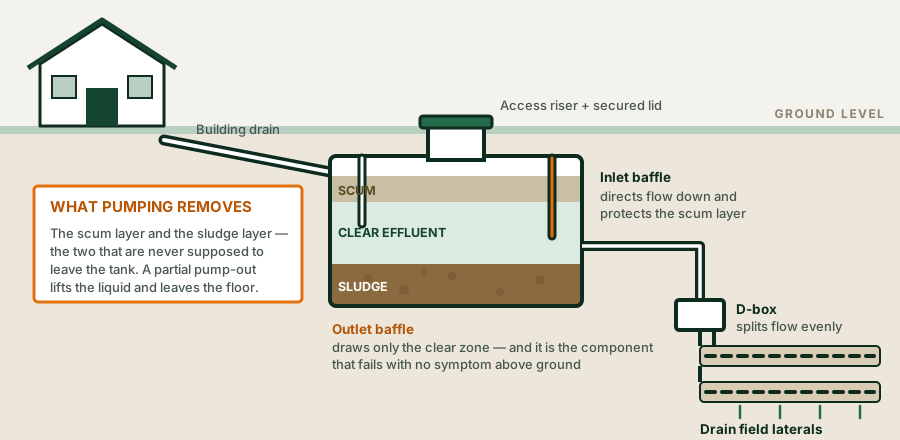
The reason a tank gets lost is that its access port is below grade with soil and turf over it. A riser brings that port to the surface with a sealed, secured lid.
It removes the search from every future visit, removes the excavation charge that goes with it, and makes it realistic for an owner to have the tank checked rather than waiting for symptoms. On a property where the lid has just been found after an hour of probing, it is the obvious next move.
When this service is the right call
The signals below are the ones that bring most Nashville properties to this service. Any one of them is worth a call; several together usually mean the system is already past the point where waiting is cheap.
- A newly purchased property with no system documentation
- A tank last serviced before the current landscaping went in
- Access port buried under gravel, decking or a raised bed
- Conflicting accounts of where the tank sits
- A previous contractor who dug in the wrong place
What is included
Every septic tank locating visit covers all eight of these. They are not tiers or add-ons — the list is what the job is.
- Search of county permit records for the original system layout
- Interior plumbing check to establish the exit point of the building drain
- Surface reading of vegetation, settlement and grade for tank signature
- Systematic soil probing on the likely alignment
- Line tracing from a cleanout where probing is inconclusive
- Tank outline and access port marked on the surface
- Location recorded with measurements from two fixed points
- Riser recommendation so the next visit needs no searching
Paying for it, and what the alternative costs
Usually folded into the pump-out where the tank is found quickly; quoted separately where extended searching or line tracing is needed.
For scale: a drain field replacement in Middle Tennessee is commonly quoted at $6,000 to $10,000, against published 2026 national figures of roughly $5,000 to $20,000. The whole economic case for maintaining a septic system is the gap between those two numbers. Pricing here is confirmed on site before work starts, and the cost estimator shows the full formula rather than asking for contact details first.
Doing it properly versus doing it cheaply
The invoice for a thorough job and a rushed one look similar. What separates them is whether the tank was emptied to the floor, whether anyone looked at the baffles while it was open, and whether the property owner ends up knowing anything they did not know before.
| What matters | Do nothing / DIY | Cheapest quote | Done properly |
|---|---|---|---|
| What leaves the tank | Not achievable — domestic septage removal requires a permitted hauler and a licensed disposal site. | Liquid drawn off; compacted sludge on the floor usually stays. | Liquid, scum and sludge removed to a visible tank floor. |
| Baffle inspection | None. Opening a tank is a confined-space hazard. | Rarely — the tank is often not emptied enough to see them. | Inlet and outlet checked with the tank empty, photographed. |
| Effluent filter | Usually unknown to the owner. | Commonly missed; a blocked filter mimics a full tank. | Located, rinsed, condition recorded. |
| What you know afterwards | Nothing new. | That it was pumped. No readings, no interval. | Sludge depth, component condition, and a dated next-service interval. |
| Effect on the drain field | Continues to degrade. | Working volume only partly restored — symptoms often return within months. | Full working volume restored; solids stop reaching the field. |
| Typical cost | $0 upfront, against a $6,000–$10,000 drain field replacement. | At or below the $275 low end, repeated more often. | $275–$525 on a 3–5 year interval. |
| Paper trail | None. | An invoice. | Dated findings for insurance, a sale, or the next inspection. |
Related resources
- Decision Guide
How Do I Find Where My Septic Tank Is Buried?
Records first, ground second, shovel last. Done in that order most Davidson County tanks are found in under an hour with almost no disturbance.
Read the guide
- Rules & Permits
Do I Need a Permit for Septic Work in Davidson County?
Pumping does not need a permit. Almost everything else that opens the ground does — and Davidson County is one of the contract counties with an extra layer.
Read the guide
Frequently asked questions
Does finding the tank mean digging up the yard?
No. Records, an interior check and surface reading usually narrow it to a few square metres, and a soil probe confirms the tank top with pinhole-sized disturbance. Excavation is limited to uncovering the access port itself.
What if the tank genuinely cannot be found?
Line tracing from an interior cleanout follows the building drain to the tank directly. It is slower, which is why it is the second approach rather than the first, but it resolves the hard cases.
Will the location be recorded for next time?
Yes — measured from two fixed points such as house corners, and included in the service record. Fitting a riser makes even that unnecessary.
Are there county records for older systems?
Often. Systems permitted under the state's subsurface sewage disposal regulations have a file with the county environmental health office, frequently including a site sketch. Very old rural installations may predate reliable record-keeping.
What area does 615 Septic Tank Pumping cover?
Nashville and Davidson County, including Bellevue, Antioch, Hermitage, Donelson, Madison, Green Hills, Goodlettsville, Old Hickory, Joelton and the surrounding Middle Tennessee area. Call to confirm coverage for a specific address.